What Does It Actually Feel Like to Study Again?
There is a version of 'going back to learning' that most adults recognise. Evenings given up to lectures that do not fit your schedule. Assessments designed for full-time students. The quiet anxiety of feeling behind before you have even started.
That version is becoming less necessary.
The University of London recently launched a suite of postgraduate microcredentials — short, credit-bearing courses built for people who are already busy, already clear about what they need to learn, and not ready to commit to a full degree. No formal application. No fixed start date. No pressure.
The idea is simple: learning should fit around a life, not the other way around.
More than a short course
What makes these microcredentials different from a typical online course is not just their flexibility. It is that the credits stack.
Complete one microcredential, and those credits count. Complete more, and they accumulate toward a full University of London award. You can step in, step away, and return when circumstances allow — without losing what you have already built. As UOL's own article on the initiative describes it, this is about moving from programmes as fixed destinations to learning as an accumulating pathway.
This matters for educators too. As modular study becomes more common and learning continues to move online, understanding what good AI-supported learning looks like in practice is increasingly relevant to course design and student experience.
Inside the Microcredentials
We went through one of the microcredentials on the platform: SCM070 — Innovations in Supply Chain Technology.
The course covers how firms can gain competitive advantage through AI, blockchain, big data analytics, and automation. It works through 10 modules — from identifying the right moment for market entry and managing innovation processes to collaboration strategies, organising innovation teams, and sustainability in supply chains. Every concept connects to how organisations actually make decisions about technology adoption.
We should say upfront: the AI study assistant in these courses is built on our platform at Noodle Factory, trained specifically on each course’s content and learning outcomes. We went through one of the courses ourselves to see how it actually behaves in practice.
Before teaching anything, it checks what you already know.
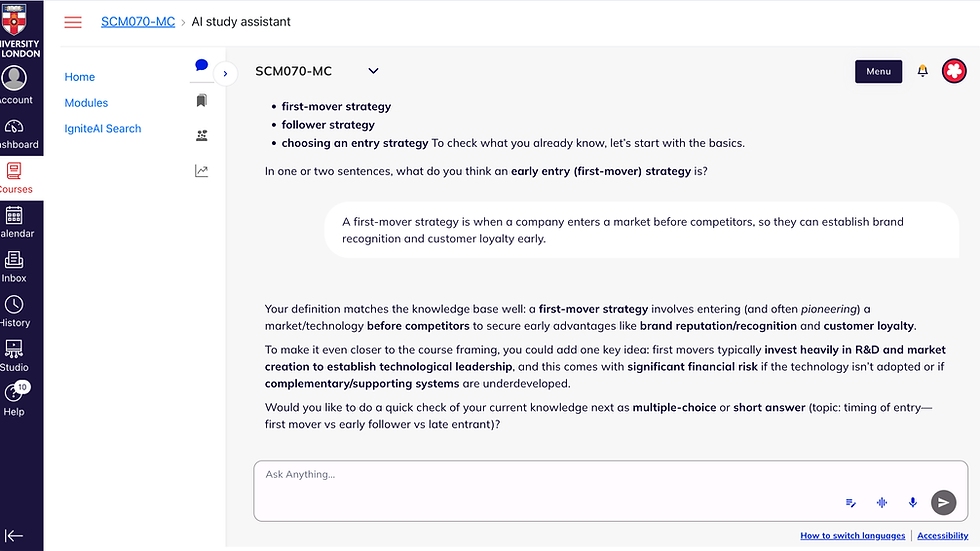
When asked for an overview of the course, the assistant first oriented us to the assessment structure — scenario-based, not exam-based — then immediately asked a question back: 'In one or two sentences, what do you think an early entry (first-mover) strategy is?' It did not deliver a lecture. It started a conversation.

When we answered, it validated the response, extended it with course-specific framing (the financial risk of first-mover positions, the role of complementary technologies), and offered to continue with either a multiple-choice or short-answer check. It teaches in stages, checks understanding as it goes, and adjusts based on what you already know.
It does not feel like a search engine. It feels like someone who has read the syllabus and is paying attention to you. Our earlier piece on what makes an AI tutor actually teach goes deeper into that distinction.
For educators designing courses, this is worth considering. The assistant shifts between roles depending on what the moment calls for — clarifying a concept, checking comprehension, running a scenario. That flexibility is what makes it useful across different kinds of learning content.
Benefits for Educators
For those designing or delivering courses, the platform gives instructors visibility that most learning environments do not. An insights dashboard tracks questions asked, quiz submissions, and role play submissions per learner. It shows where learners are progressing and where they are getting stuck. The AI assistant handles the repetitive explanations and the questions that arrive outside office hours. This allows the instructor's attention to go toward the work that genuinely needs a human touch.
There is also a Question Board — a community layer where learners can post questions by topic, see what others have asked, and engage with the course beyond their own session. Even without a fixed cohort moving through together, it keeps the learning from feeling solitary.
Then there is the roleplay. In the SCM070 course, the assistant takes on the role of a line manager in a midpoint review. The scenario: your firm is deciding when to enter the market with a new supply chain technology. You have to justify your timing choice — first mover, early follower, or late entrant — by weighing opportunity against risk and referencing factors like switching costs, complementary technologies, and user readiness. It is not abstract. It puts course concepts directly into a professional decision-making context.

For more on how this works in practice, see How AI Role Play Transforms Teaching and Learning.
The Longer Shift in Education
The University of London has been building toward this for some time. Their microcredentials are not a standalone product — they are a first step toward a broader model of lifelong learning: modular, flexible, and designed to span a career rather than a single enrolment period.
That shift is already happening across higher education. What the UOL model adds is a clear credit structure, a genuine stackability pathway, and an AI-supported learning experience that adapts to each learner rather than delivering the same content to everyone.
For learners, that combination is worth paying attention to.
For educators, it is worth experiencing first-hand.


